You do not need a complicated puzzle setup or a long play session every time your cat needs something interesting to do. Five focused minutes can be enough to add movement, hunting-style play, problem-solving, or novelty to an otherwise ordinary part of the day.
Save This Idea on Pinterest
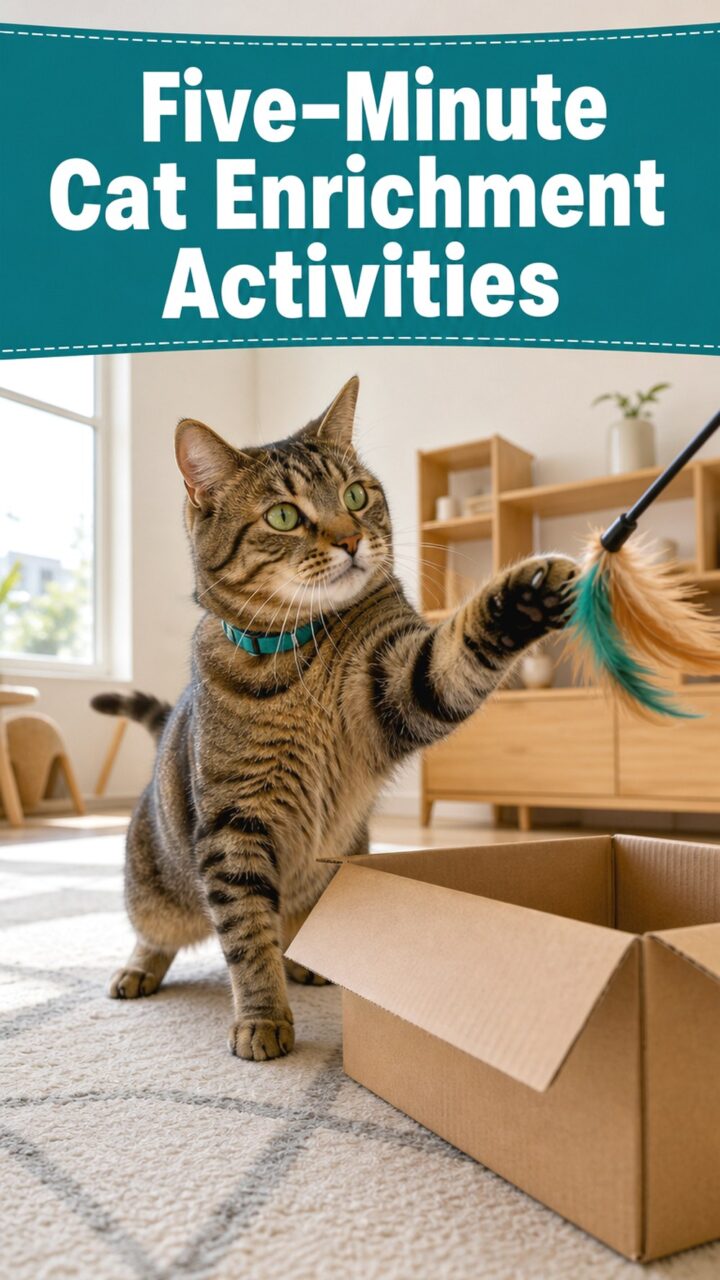
Five-Minute Cat Enrichment Activities for Busy Days
Save to PinterestThe best five-minute cat enrichment activities are short enough to fit between other tasks but specific enough to hold your cat’s attention. Instead of leaving out the same toy again, change what the cat gets to chase, investigate, search for, or figure out.
Use your cat’s mood to choose the activity. A cat already racing through the hallway may enjoy a chase game, while a cat watching quietly from a chair may respond better to a food search or short training session.
Pick an Activity for the Mood You See
| Your cat seems… | Try… | What you need |
|---|---|---|
| Restless and ready to chase | Wand-to-box ambush | Wand toy and cardboard box |
| Energetic but easily distracted | Paper-ball hallway chase | Plain paper |
| Interested in food | Three-stop treat hunt | Part of the normal meal or treats |
| Curious and patient | Cup-choice puzzle | 2–3 sturdy paper cups |
| Eager to investigate | Cardboard box search | Box and a familiar toy |
| Food motivated but calm | Towel-fold forage | Small towel and food |
| Focused on you | Hand-target training | Small food rewards |
| Bored with familiar rooms | Five-minute room reset | Box, stool, or familiar toy |
You do not need to complete all of them in one day. Rotating a few different activities usually keeps the experience more interesting than repeating the same game every time.
For Cats Ready to Move
1. Play a Wand-to-Box Ambush Game
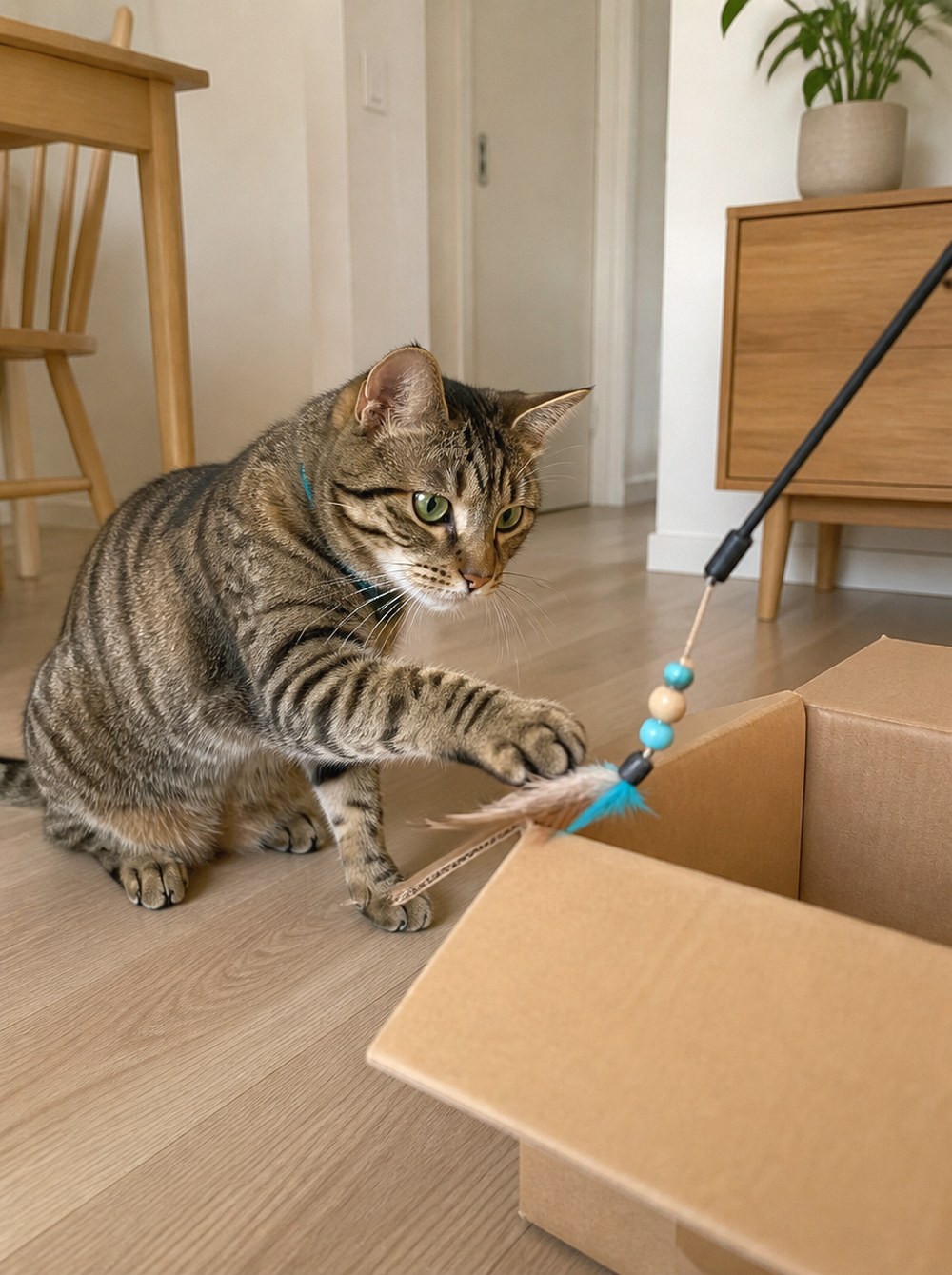
Place an empty cardboard box on its side and move a wand toy around the outside edges rather than waving it directly in front of your cat’s face.
Let the toy disappear behind the box, peek around a corner, pause, and move again. Those brief disappearances make the game less predictable and give your cat opportunities to watch, stalk, chase, and pounce.
A five-minute session can include several short bursts. Give your cat pauses between them instead of keeping the toy in constant motion.
If your cat prefers slower play, drag the toy gradually along the floor and leave longer pauses. A more energetic cat may enjoy quicker movements across two sides of the box.
Always supervise wand toys, especially those with strings, feathers, or fabric pieces. Put the toy away after the session rather than leaving it available for unsupervised chewing.
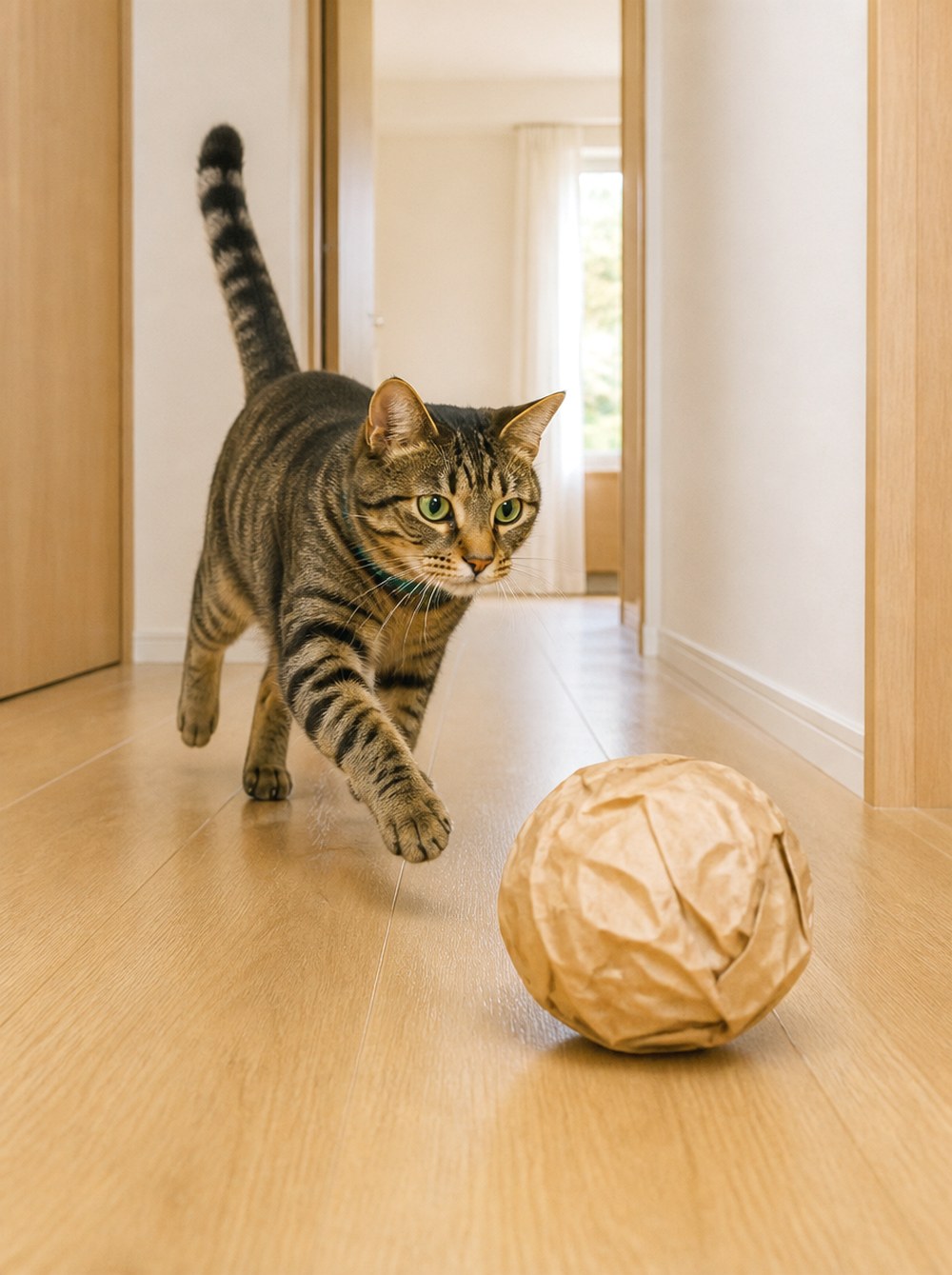
2. Turn One Sheet of Paper Into a Hallway Chase
Loosely crumple a plain sheet of paper into a ball large enough that your cat cannot swallow it. Roll or gently toss it along an uncluttered hallway or across an open room.
The irregular bounce and light rustling can make the object move differently from a standard cat ball.
Instead of repeatedly throwing it at your cat, send it away from the cat so there is something to pursue. Try two or three rolls, pause, and restart when your cat shows interest again.
Remove the paper if your cat begins tearing off and swallowing pieces. Cats that chew paper heavily are better matched with a sturdy cat-safe ball.
You May Also Like


3. Give a Cardboard Box a New Job
A box your cat ignored yesterday may become interesting again when you change how it is positioned.
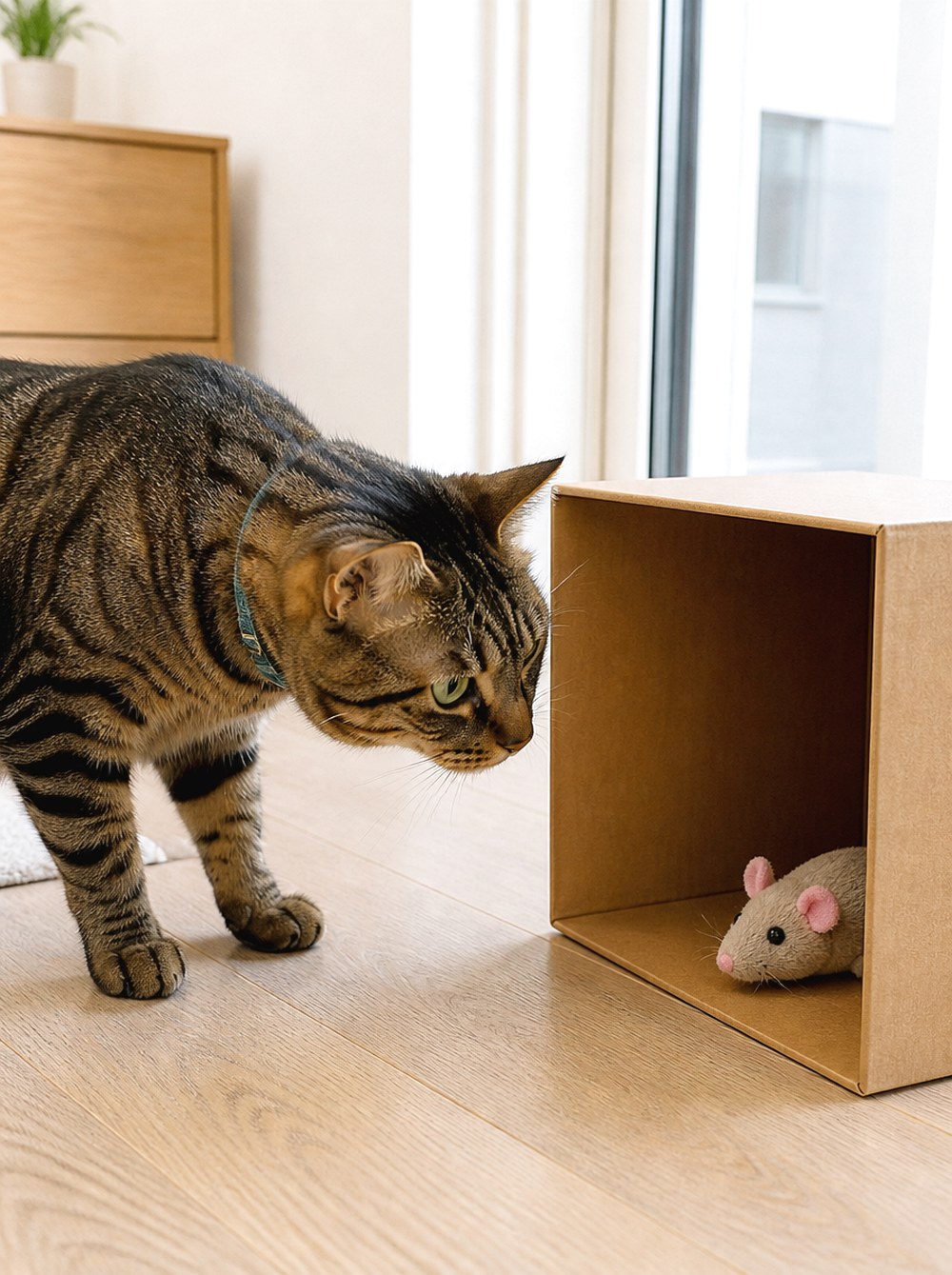
Set one sturdy box on its side and place a familiar toy just inside the entrance. Let your cat investigate rather than pushing the cat into the box or repeatedly moving the toy.
You can also turn the box so a different opening faces the room or place it beside a chair to create a new route around it.
The goal is not to build an elaborate obstacle course. Five minutes of changed positioning can make a familiar space worth examining again.
Remove boxes that are wet, heavily damaged, covered in loose tape or staples, or being eaten rather than explored.
When Your Cat Wants to Search and Solve
4. Make a Three-Stop Treat Hunt
Instead of handing over several treats in one place, divide a small amount of food among three easy-to-find locations.
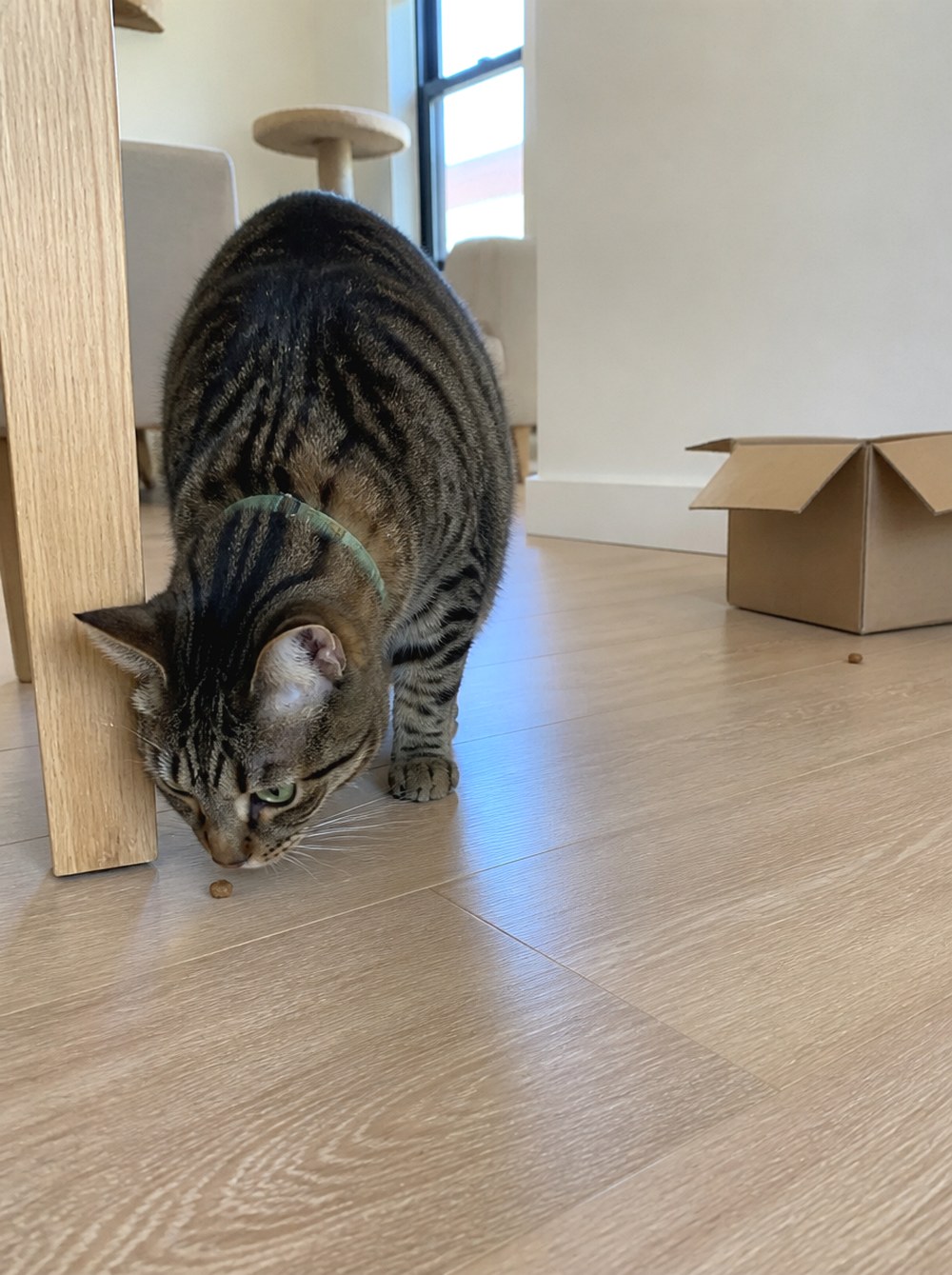
For a beginner, put pieces where your cat can partly see them: beside a table leg, near the edge of a cat bed, and just outside an open box. Once your cat understands the game, make one location slightly less obvious.
Keep the search area small enough that the activity remains manageable within five minutes.
If you use food for enrichment regularly, consider using a portion of your cat’s normal meal rather than continually adding extra treats. Cats with prescribed diets or feeding restrictions may need a veterinarian’s guidance before changing how food is offered.
5. Try a Two-Cup Choice Puzzle
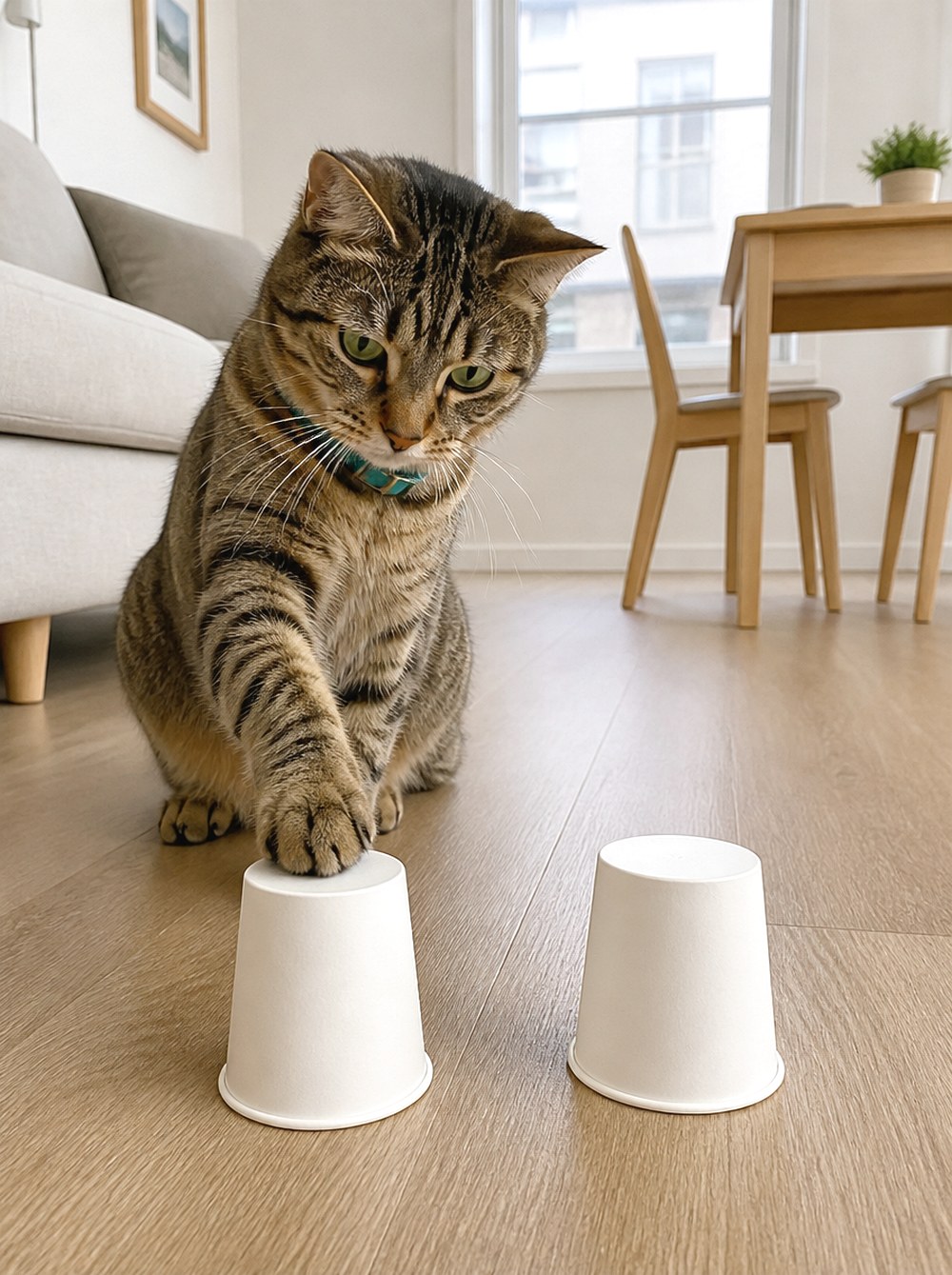
Place two sturdy paper cups upright on the floor. Let your cat see you put one piece of food beneath one cup, then turn both cups upside down.
Give the cat time to sniff, paw, or nudge the correct cup.
At first, keep the answer obvious. The point is not to make the puzzle difficult enough to cause frustration. Once your cat understands the game, you can vary which cup covers the food or add a third cup.
Stay nearby so the cups do not become chew toys. Stop if your cat starts ripping off pieces instead of investigating them.
6. Fold a Small Food Search Into a Towel
Lay a clean small towel flat and place a few pieces of your cat’s normal food several inches apart. Make two or three loose folds so some pieces remain easy to find while others require sniffing or gentle pawing.
Avoid tightly rolling the towel or tying knots. The activity should invite searching without trapping food inside an object your cat has to tear apart.
For a first attempt, leave part of each food piece visible. Increase the folds only after your cat understands what to do.
Supervise the entire activity, particularly if your cat likes to chew fabric or pull threads. Put the towel away if it becomes damaged.

Quieter Five-Minute Challenges
7. Teach a Hand Target
A short training session can provide enrichment without requiring your cat to sprint around the room.
Hold two fingers or a closed hand a few inches from your cat’s nose. When the cat naturally leans forward to investigate or touches your hand with its nose, immediately reward that action with a tiny food reward.
After a few repetitions, move your hand slightly to one side so the cat has to turn or take a step to reach it.
Keep the session brief and voluntary. If your cat walks away, the session is finished. There is no need to repeatedly call the cat back.
Once the behavior becomes familiar, a hand target can also give you another way to guide your cat a short distance without picking the cat up.

8. Do a Five-Minute Room Reset
Enrichment can come from changing the environment rather than adding another toy.
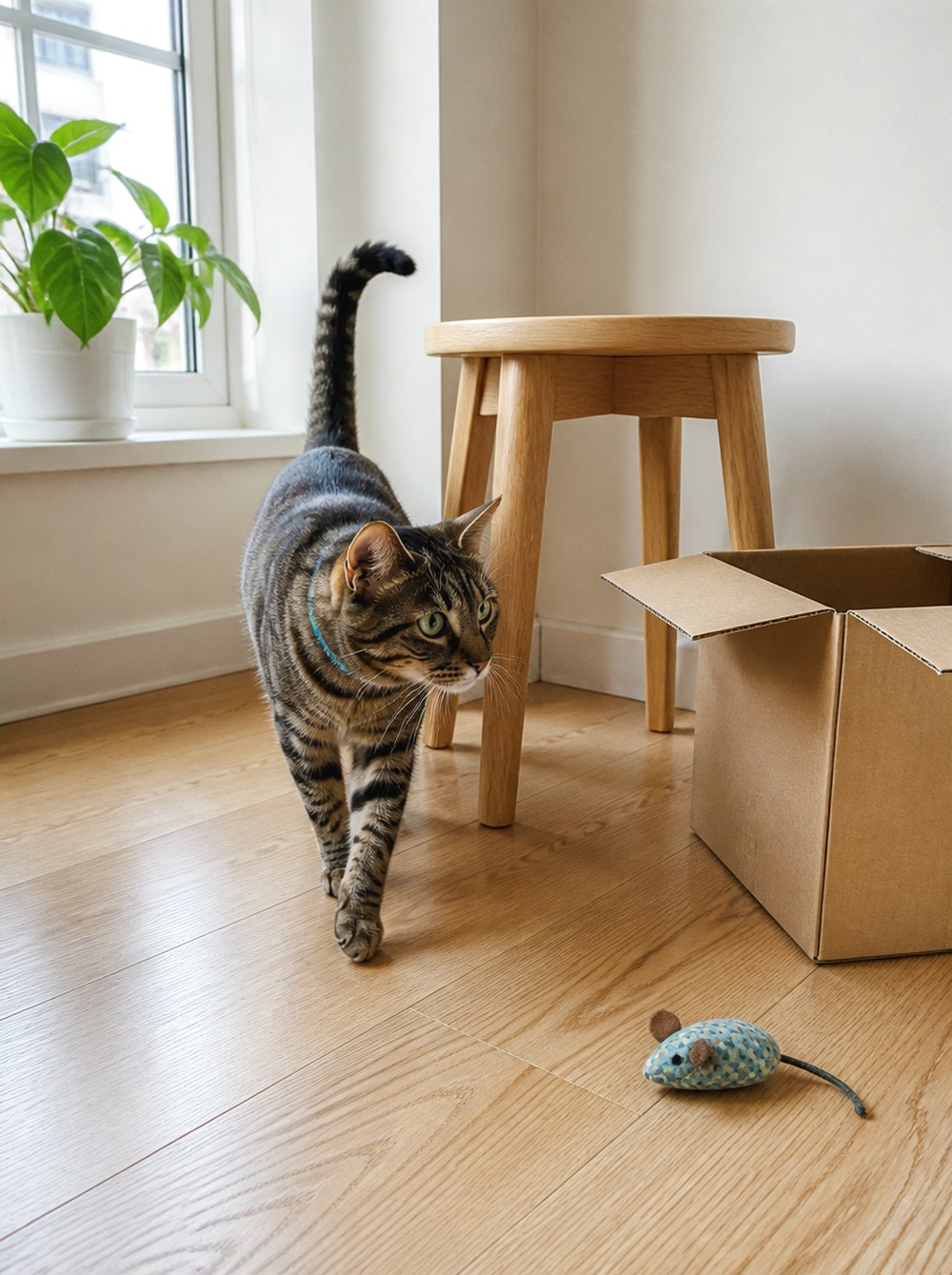
Choose one small part of the room and rearrange two or three safe, familiar objects. For example, move an empty cardboard box beside a sturdy stool, place a familiar toy near the new route, and leave enough open floor space for your cat to investigate.
Then stop rearranging and let the cat explore.
This works best when the changes are modest. Completely transforming a room can be more disruptive than interesting for some cats.
Keep furniture stable, maintain clear escape routes, and never block access to water, litter boxes, resting places, or other resources.
You May Also Like



Make Five Minutes Feel Different Each Time
The activity does not need to become harder every day. Variation matters more.
You might use a chase game on one day, a food-search activity the next, and two minutes of target practice followed by quiet exploration on another. Changing the type of challenge prevents every enrichment session from becoming the same routine with a different object.
Watch the cat in front of you rather than trying to complete a predetermined session. Useful signs of engagement can include watching closely, approaching voluntarily, sniffing, stalking, pawing, chasing, or returning to investigate after a pause.
Stopping is also part of the activity. If your cat loses interest, walks away, hides, becomes agitated, or starts chewing materials that were meant only for supervised investigation, end the session and remove the setup.
Sudden changes in normal activity, appetite, bathroom habits, breathing, mobility, or behavior deserve more attention than a new enrichment plan. Contact a veterinarian when a change is concerning or persistent.
A Practical Rotation for Busy Weeks
You can keep five-minute enrichment varied without planning a formal schedule:
- Movement day: wand-to-box play
- Search day: three-stop food hunt
- Problem-solving day: two-cup puzzle
- Exploration day: cardboard box or room reset
- Training day: hand target
Repeat whichever activities your cat clearly enjoys, but change the location, movement pattern, or difficulty gradually rather than constantly buying new supplies.
A short session that your cat chooses to participate in is more useful than a complicated activity that stays on the floor untouched. Start with one of these five-minute cat enrichment activities today, see how your cat responds, and let that response decide what you offer next.
