Dog toys have a way of spreading across the living room. A ball rolls under the sofa, plush toys collect beside the dog bed, and the one storage basket you bought eventually becomes an overflowing pile.
Save This Idea on Pinterest

12 Dog Toy Storage Ideas for a Tidy Living Room
Save to PinterestThe right solution should do more than hide the mess. It should fit the room, keep frequently used toys easy to reach, protect rotation toys from curious dogs, and leave enough clearance for vacuuming and everyday foot traffic.
These 12 dog toy storage ideas range from simple baskets to concealed furniture storage. Some give dogs independent access, while others keep puzzles, outdoor toys, or special play items behind closed doors.
Quick List: Living Room Dog Toy Storage Ideas
- Low woven basket beside the sofa
- Wall-mounted canvas pockets behind a door
- Storage ottoman with a removable tray
- Console table with two shallow baskets
- Cube shelf with open and closed zones
- Sideboard cabinet with pull-out bins
- Window bench with deep drawers
- Slim rolling cart beside the media unit
- Under-sofa bin for rotation toys
- Soft-sided drawstring play mat bag
- Built-in alcove drawer
- Freestanding wooden toy box with an open front cutout
How to Choose Living Room Dog Toy Storage
Start with the toys rather than the container. Gather everything in one place and separate the collection into broad groups such as plush toys, balls, tug toys, puzzles, outdoor toys, and items reserved for supervised play.
Next, consider how your dog interacts with storage. A calm adult dog may use a low basket without bothering the basket itself. A puppy or enthusiastic chewer may pull apart fabric handles, wicker strands, labels, or wooden edges. In that situation, closed drawers or hard-sided furniture can be easier to manage.
Toy size matters too. Balls and other toys should be appropriately sized for the dog, while worn toys that are breaking into small pieces should be removed rather than returned to storage.
Measure three things before buying anything:
- The available floor or furniture space
- The height your dog can comfortably reach
- The total volume of toys after damaged and unused items are removed
Open storage works well for a small daily selection. Closed storage is better for rotation toys, complicated puzzles, outdoor equipment, or anything that should only come out during supervised play.
Finally, check the cleaning route. A container that looks attractive but cannot be wiped, lifted, vacuumed beneath, or fitted with a washable liner may quickly become frustrating.
1. Low Woven Basket Beside the Sofa
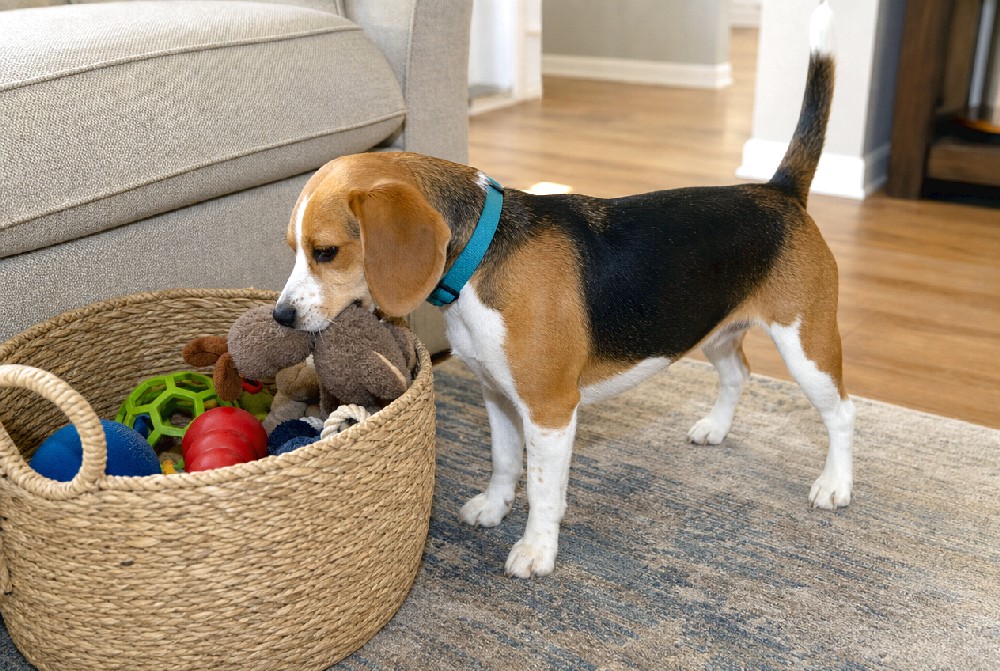
A low basket is the simplest way to create a clear home for everyday toys. Place it beside the sofa, at the end of a media console, or near the dog bed where it will not narrow a walkway.
Look for a wide opening and a rim low enough for your dog to reach over without tipping the basket. A tightly woven rope basket is generally easier to move than a rigid wicker basket, while a removable fabric liner helps catch fur and dirt.
Keep only a manageable selection inside. When a basket is packed above the rim, dogs usually pull out several toys while searching for one favorite.
This low-cost setup suits small or medium collections and owners who are comfortable allowing independent toy access. For a dog that chews baskets, use the same placement with a smooth plastic or powder-coated metal bin instead.
2. Wall-Mounted Canvas Toy Pockets Behind a Door

You May Also Like


Wall-mounted pockets save floor space and make use of an area that might otherwise remain empty. An over-the-door organizer is the most renter-friendly version because it requires no permanent installation.
Use the pockets for lightweight plush toys, flat tug toys, spare bandanas, or collapsible enrichment items. Dense rubber toys can make fabric pockets sag, so place heavier items elsewhere.
This setup is best for human-controlled storage rather than self-service. Mount or hang the organizer high enough that your dog cannot pull on the fabric, straps, or door hardware.
Choose washable canvas with open-topped pockets so fur can be shaken out easily. Neutral fabric helps the organizer blend into the room instead of looking like temporary utility storage.
3. Storage Ottoman with a Removable Tray
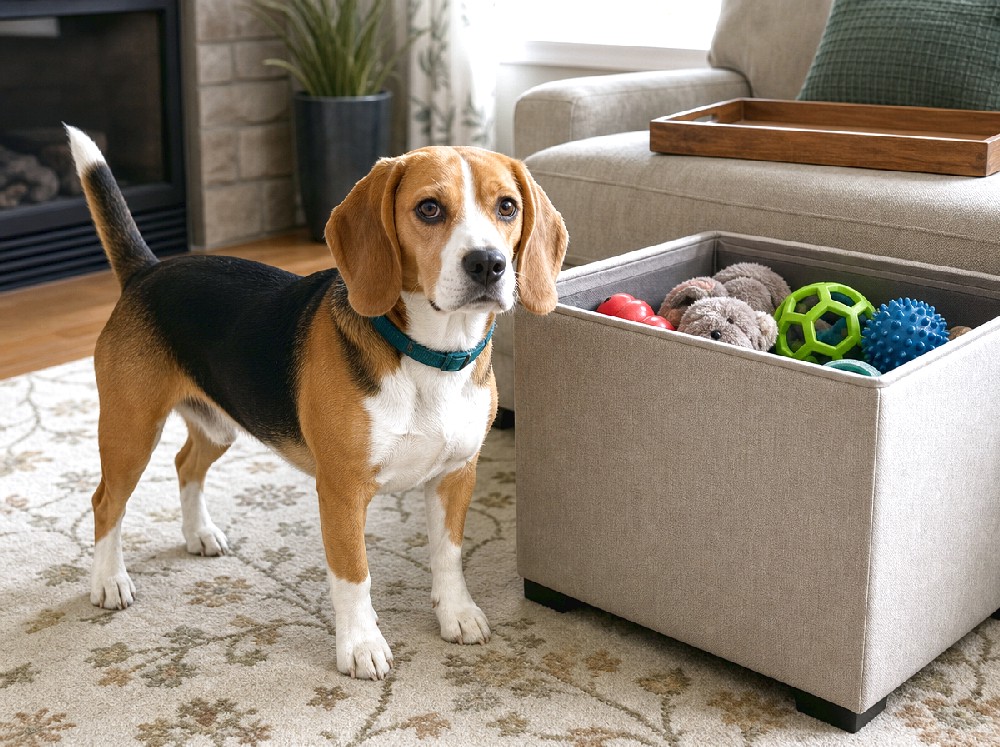
A storage ottoman can hold toys while serving as a footrest, occasional seat, or coffee-table substitute. It is especially useful when the living room does not have space for a separate toy cabinet.
A model with a removable top is often easier to use than a deep hinged chest. For hinged designs, look for controlled or soft-closing hardware and keep your dog away while the compartment is open.
Place sturdy rubber toys, puzzles, and seasonal items at the bottom. A shallow washable bin inside the ottoman can prevent fur and toy residue from collecting against the upholstery.
Because the toys remain concealed, this approach works well in formal living rooms or shared spaces where visual clutter is the main concern. The tradeoff is that your dog cannot select a toy without help.
4. Console Table with Two Shallow Baskets
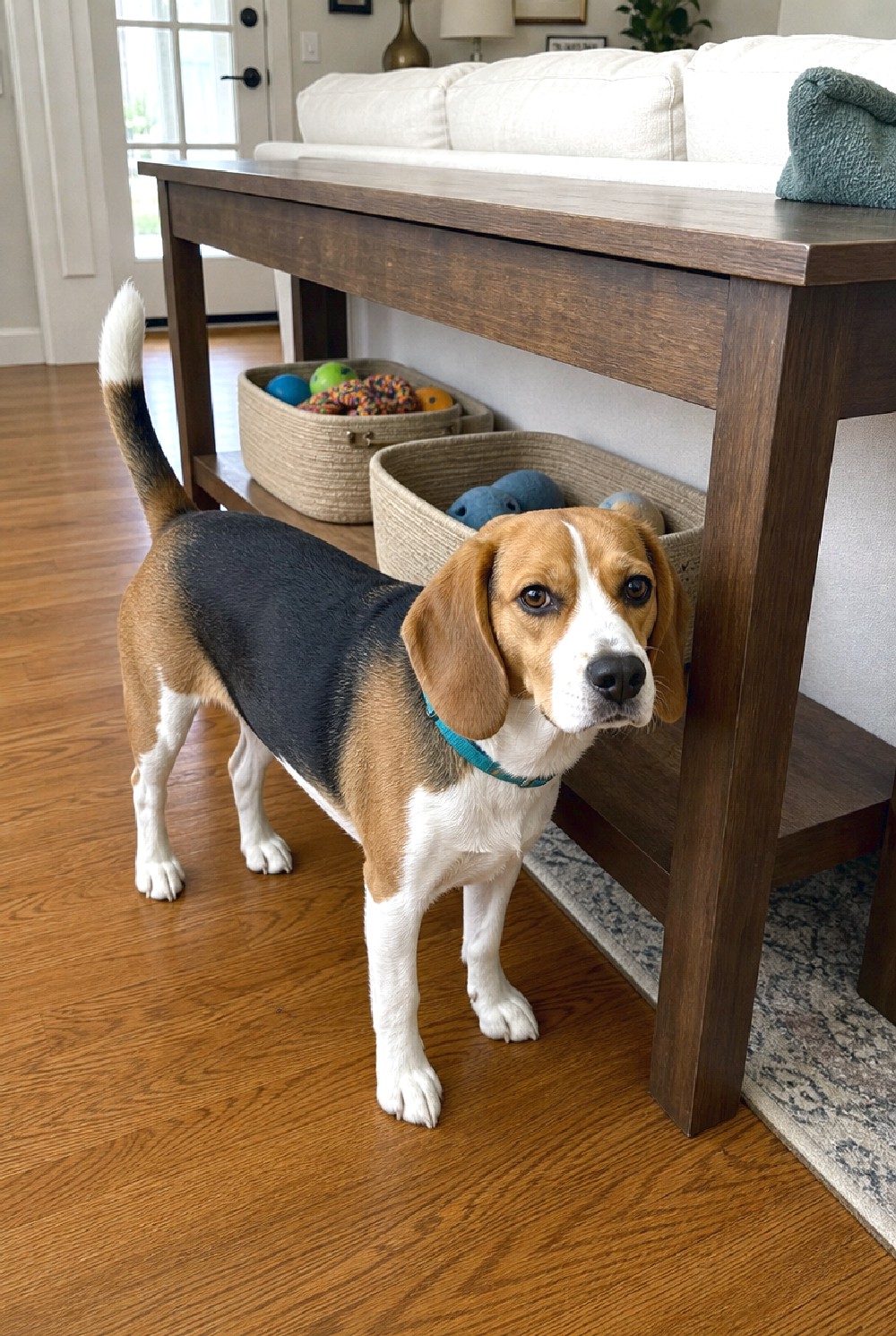
A console table creates storage without adding another single-purpose piece of pet furniture. Slide two shallow baskets onto the bottom shelf: one for toys currently in use and one for items waiting to be cleaned or returned to rotation.
Shallow baskets are preferable to one deep container because small balls and chew toys do not disappear beneath a pile of plush toys. Leave a little open space above each basket so it can slide out without catching on the shelf.
This setup works behind a sofa or along an unused wall. Check that the baskets do not project beyond the table legs, where someone could catch a foot on them.
Choose baskets with smooth built-in hand openings rather than dangling rope handles if your dog likes to chew loose materials.
5. Cube Shelf with Open and Closed Zones
A cube unit can combine dog-accessible storage with concealed rotation space. Keep one bottom cube open with a low bin for everyday toys, then use doors or fitted boxes in the remaining cubes.
The divided layout makes it easier to organize toys by purpose. For example, the open cube can hold plush and fetch toys, while a closed cube contains puzzles and another holds cleaned backup toys.
Select a low, stable unit that fits against the wall without crowding the sofa. Secure furniture according to the manufacturer’s instructions, especially when several cubes are stacked vertically.
This option has a larger footprint than a basket, but it works well for households that need dog storage and general living-room storage in the same piece of furniture.
6. Sideboard Cabinet with Pull-Out Bins
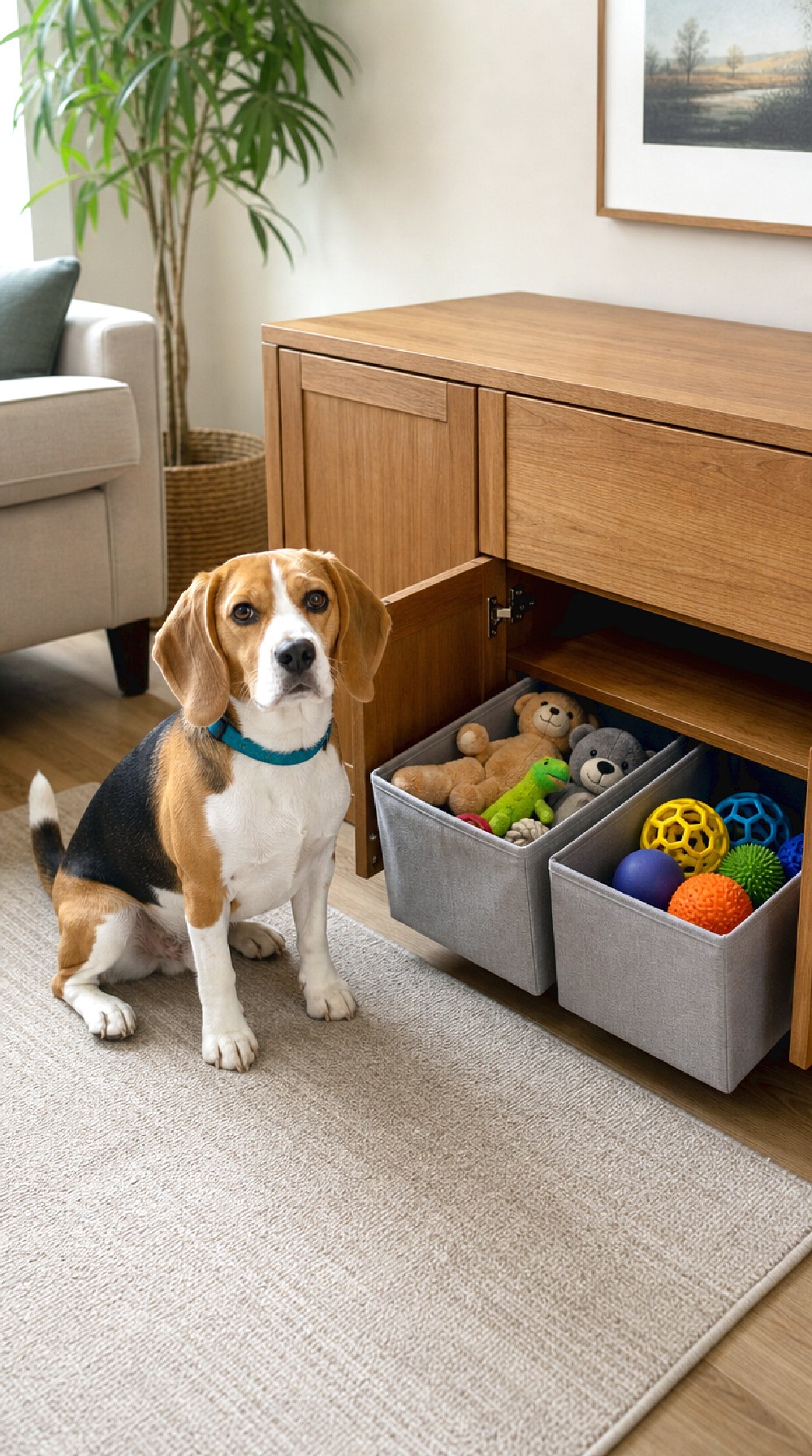
A sideboard is a practical choice for a large toy collection that needs to disappear completely at the end of the day. It can also store blankets, cleaning cloths, spare covers, and other living-room supplies.
Instead of placing toys loose on the shelves, use pull-out bins inside the cabinet. Separate soft toys from hard rubber items so the contents are easier to inspect and clean.
Keep the most frequently used bin near the front. Outdoor toys or items that may carry sand and soil should have their own washable container and should be completely dry before the doors are closed.
A sideboard costs more than a basket, but it provides the cleanest visual result. It is particularly useful for dogs that chew accessible storage containers.
7. Window Bench with Deep Drawers
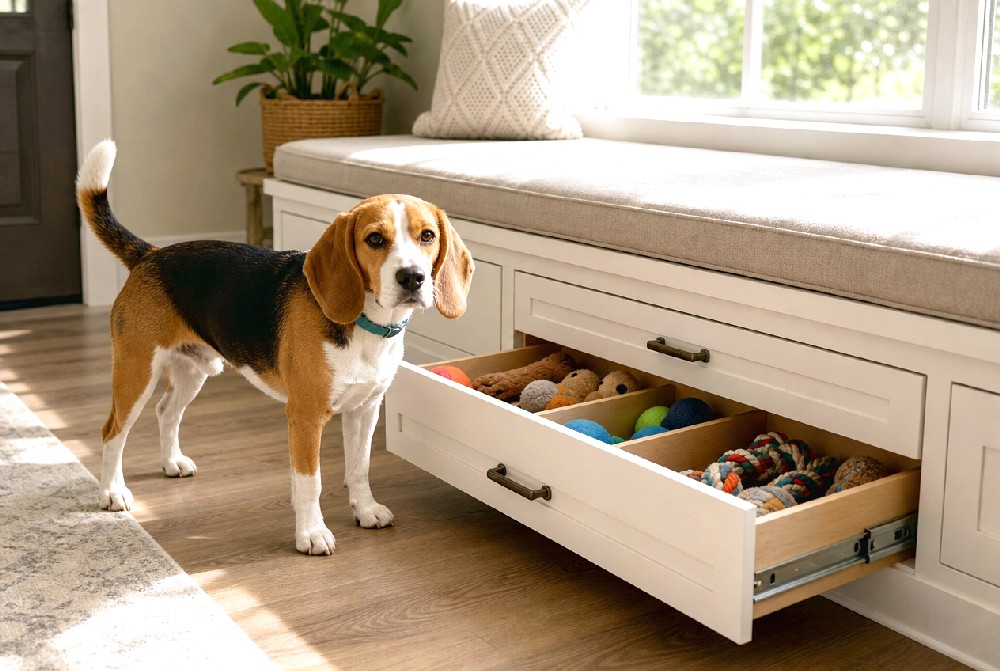
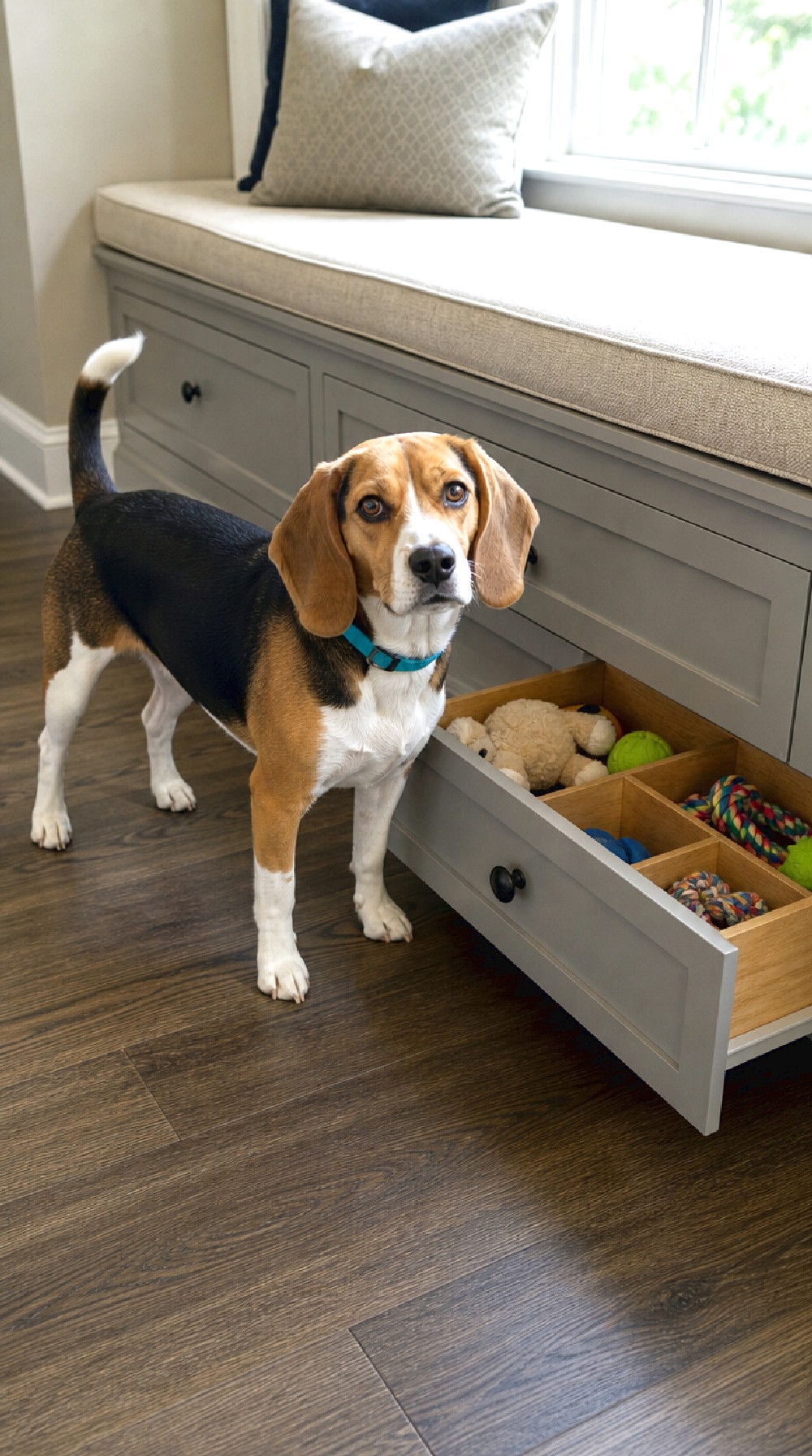
A window bench can turn an underused wall into seating and concealed toy storage. Deep drawers are easier to manage than a large lift-up seat because each category can be opened independently.
Use one drawer for everyday toys and the other for rotation items, spare blankets, or travel supplies. Drawer dividers or small removable tubs keep balls from rolling to the back.
This solution works best in living rooms with a wide window and enough depth for seating without blocking circulation. A custom built-in provides the neatest finish, but modular drawer benches can create a similar result for less money.
Choose washable seat covers and leave enough room in front of the drawers for them to open fully.
8. Slim Rolling Cart Beside the Media Unit
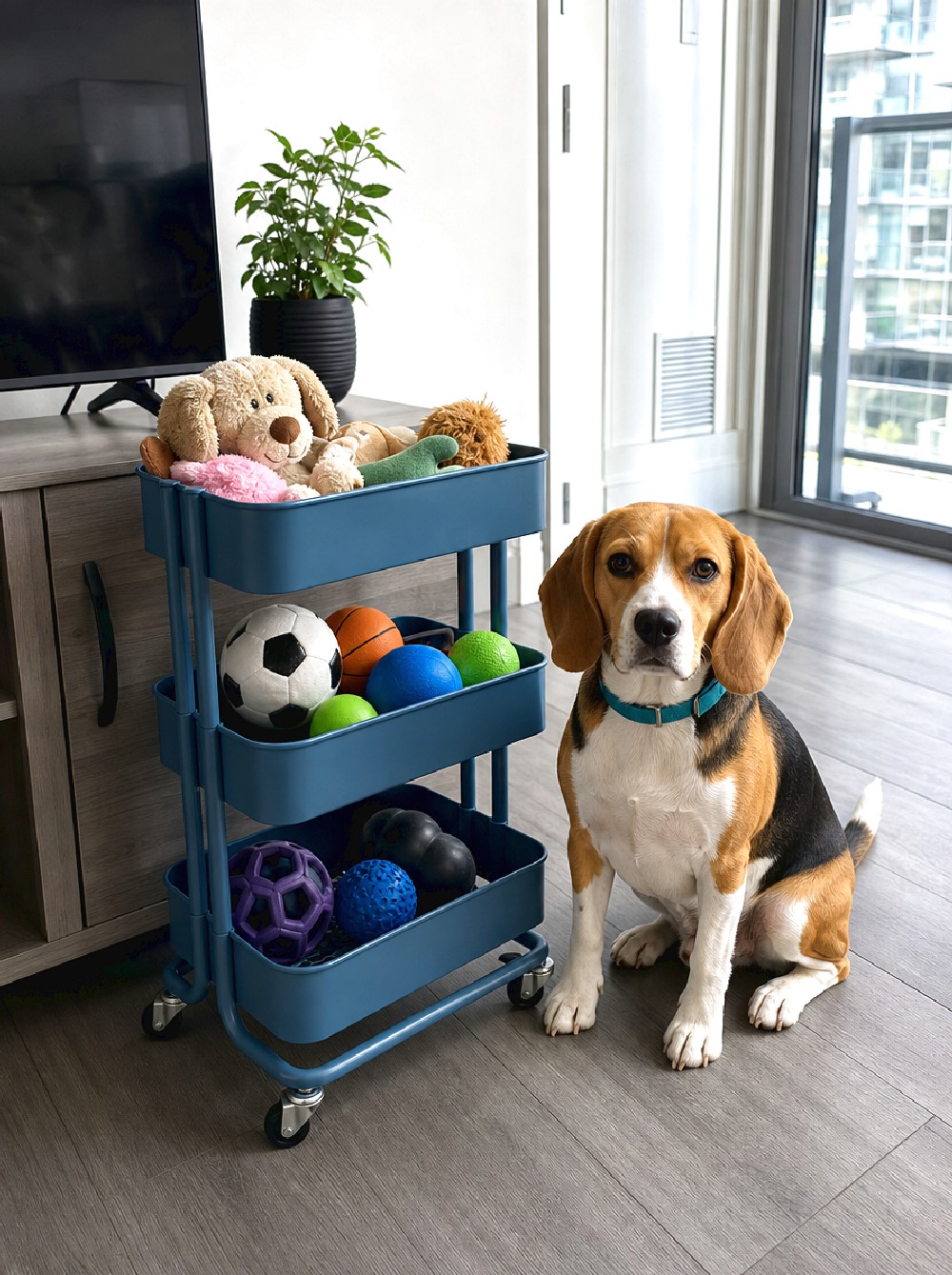
A narrow rolling cart is useful when toys move between the living room, patio, and another play area. It offers vertical storage without requiring a wide section of floor.
Use shallow bins or trays on each tier. Soft toys can go on top, fetch toys in the middle, and heavier rubber items on the bottom to keep the cart balanced.
Select a cart with locking wheels and park it beside a media unit, in a recessed corner, or behind an armchair. Avoid hanging toys with long straps or ropes from the sides, where they could trail across the floor.
A rolling cart is inexpensive, renter-friendly, and easy to clean around. It is less discreet than a cabinet, so it works best when the toy collection is kept edited and orderly.
9. Under-Sofa Bin for Rotation Toys
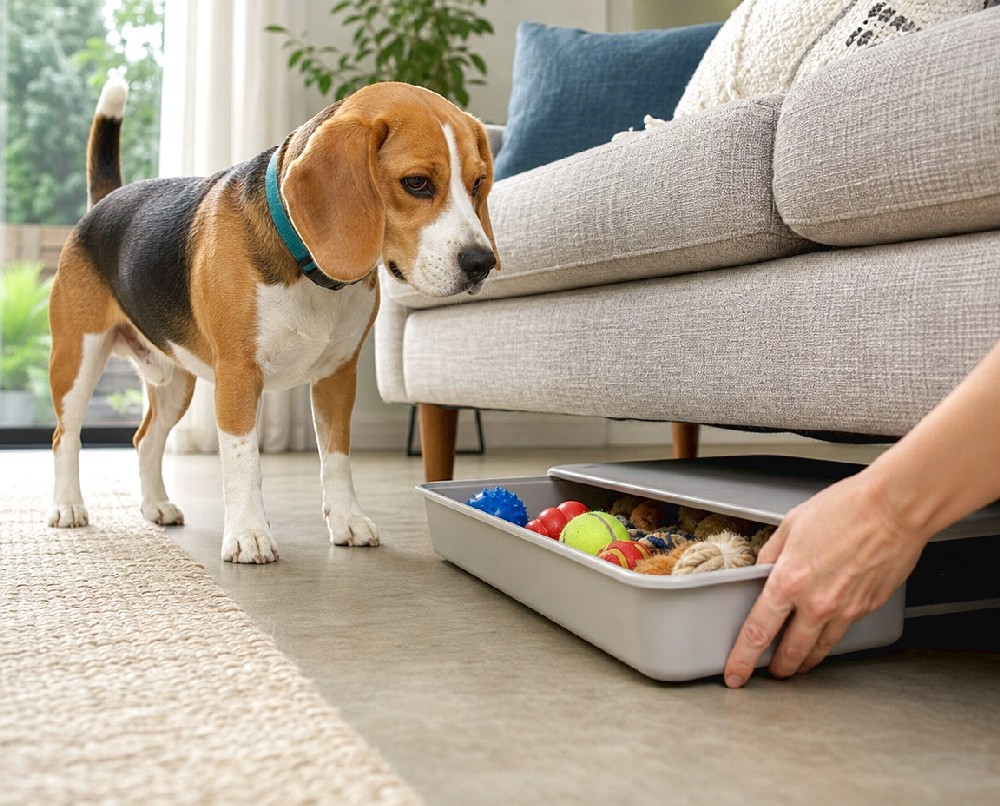
The space beneath a raised sofa can hold a flat, lidded bin containing toys that are temporarily out of rotation. This keeps backups nearby without using visible wall or floor space.
Measure the lowest point beneath the sofa rather than measuring only at the front edge. Casters, center supports, or reclining mechanisms can reduce the usable clearance.
Choose a smooth bin that slides without scratching the floor. A lid keeps dust and fur away from the toys, while a label on the short end helps identify the contents without pulling the bin out completely.
Under-sofa storage is not convenient for daily access, so reserve it for clean, dry toys that you intend to swap into the active collection later.
10. Soft-Sided Drawstring Play Mat Bag
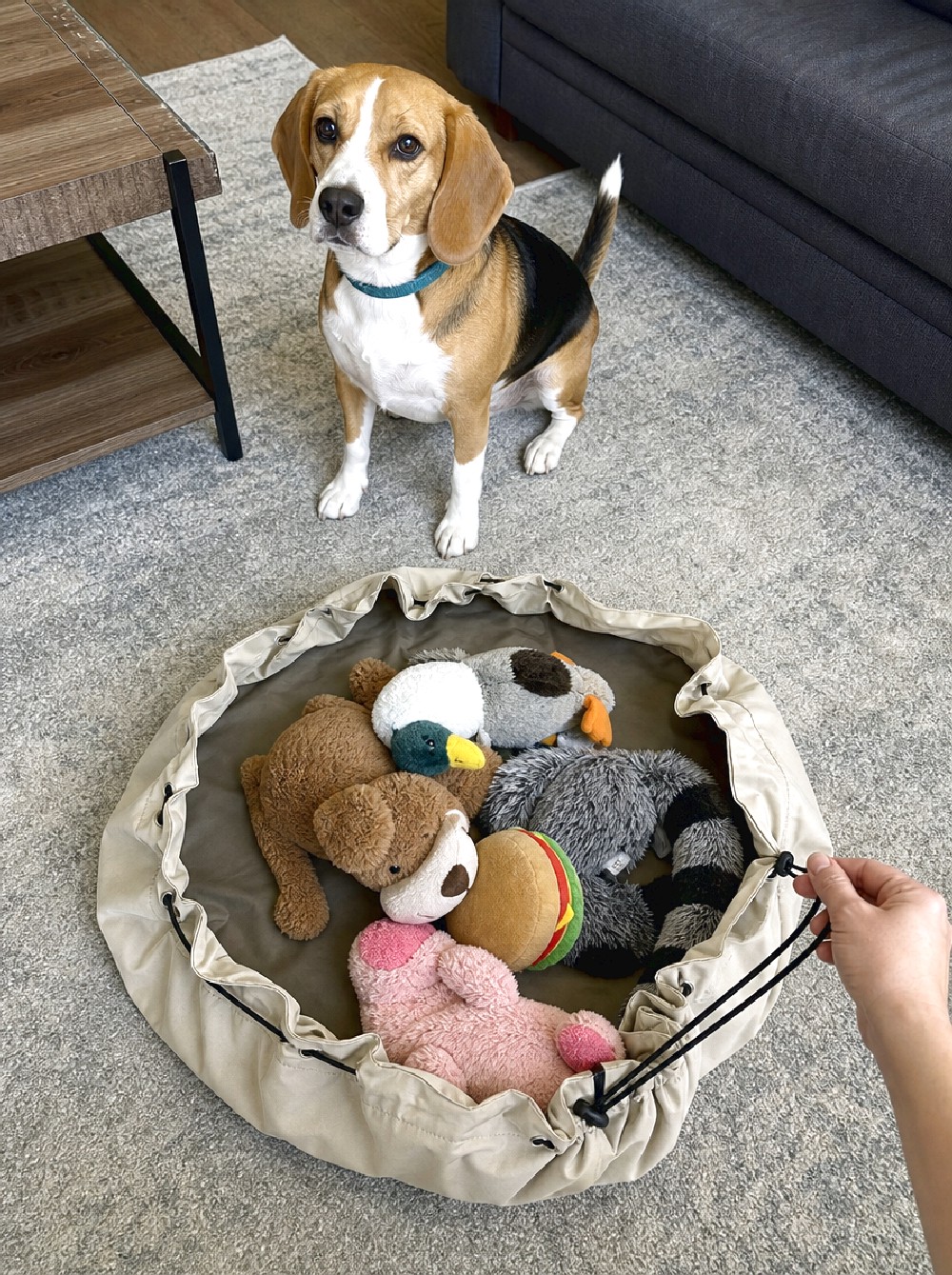
A drawstring play mat opens flat on the floor, creating a defined place for a pile of lightweight toys. After playtime, the edges gather into a soft storage bag.
This design is especially helpful for plush toys because cleanup involves pulling the mat together rather than carrying toys across the room one at a time. Once closed, the bag can sit in a corner or on the bottom shelf of a cabinet.
Choose durable, washable fabric and inspect the drawcord regularly. Tuck the cord inside or place the closed bag beyond your dog’s reach when it is not being handled.
This solution folds nearly flat when empty, making it suitable for apartments, temporary living arrangements, and homes that do not need permanent storage furniture.
11. Built-In Alcove Drawer
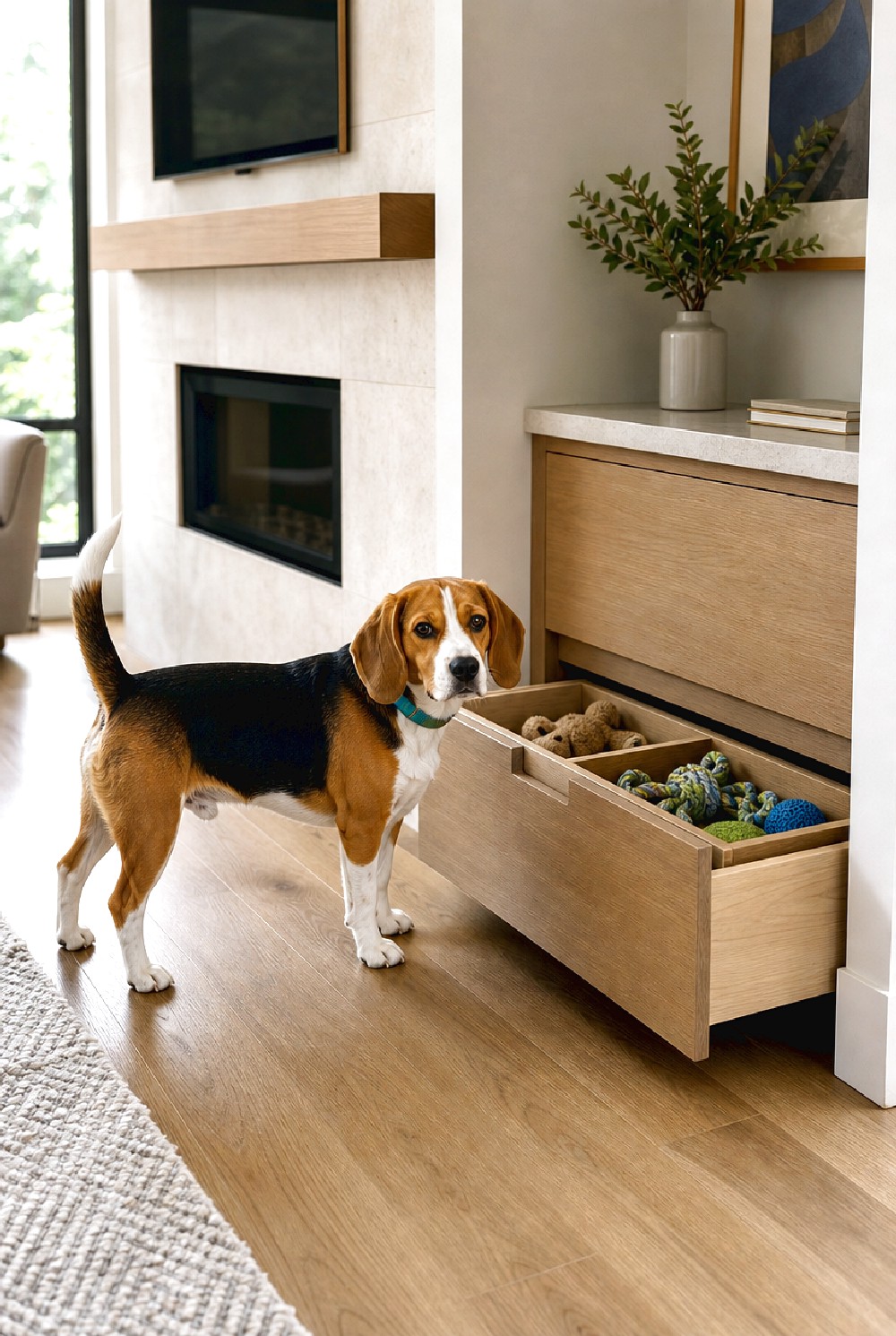
A shallow alcove beside a fireplace, chimney breast, or media wall can accommodate a custom drawer without taking space from the center of the room.
A full-extension drawer provides a clear view of the entire collection. Use removable trays inside so dirty bins can be carried to a sink or utility area without removing the drawer itself.
Keep the front flush with nearby cabinetry and choose a handle that does not project into the walkway. A push-to-open front creates a cleaner appearance, although the mechanism should be firm enough that a curious nose cannot open it easily.
This is one of the more expensive options, but it uses awkward architecture efficiently and creates a permanent storage zone.
12. Freestanding Wooden Toy Box with an Open Front Cutout
You May Also Like


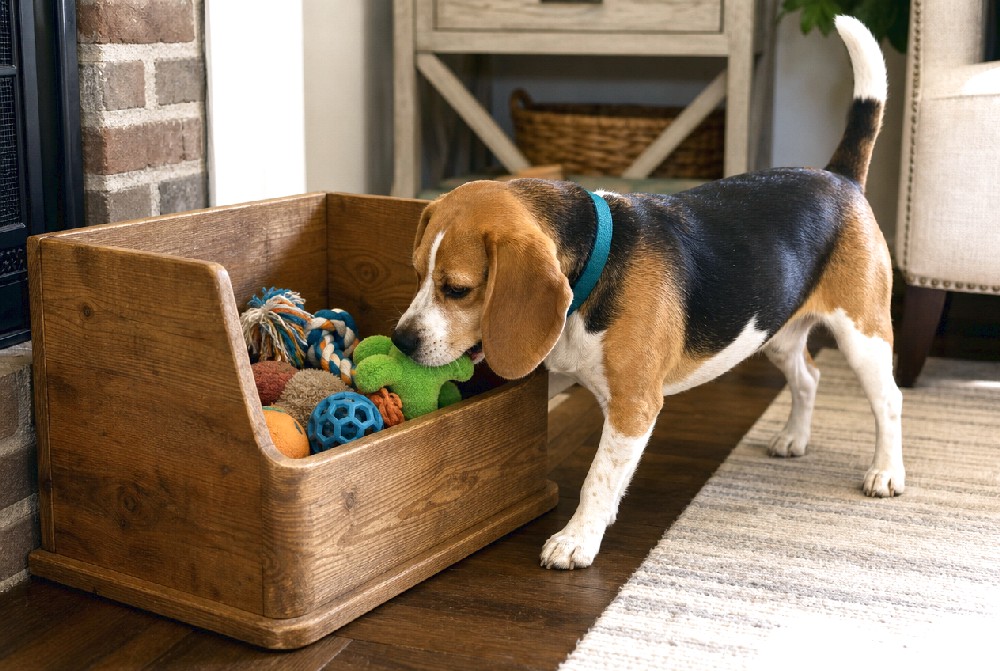
An open-front wooden box gives a traditional toy chest a more practical dog-friendly shape. The front cutout allows toys to be retrieved without a heavy lid, and the solid sides prevent the collection from spreading across the floor.
The box should have smooth, rounded edges and a stable base. Seal the interior with an easy-to-wipe finish suitable for the material, following the product manufacturer’s directions.
A carpenter or experienced DIYer can size the opening for the dog and the toy collection. A small Beagle needs a lower opening than a tall retriever.
This idea suits rustic, farmhouse, or transitional living rooms. It is not the best choice for a dog that persistently chews wooden furniture; use a closed cabinet or metal bin instead.
Dog Toy Storage Comparison
| Storage idea | Best fit | Dog access | Space and cost |
|---|---|---|---|
| Low woven basket | Small daily collection | Independent | Small footprint, low cost |
| Wall-mounted pockets | Lightweight toys | Human-controlled | No floor space, low cost |
| Storage ottoman | Multipurpose rooms | Human-controlled | Medium footprint, moderate cost |
| Console with baskets | Long walls or sofa backs | Optional | Medium footprint, moderate cost |
| Cube shelf | Mixed open and closed storage | Partial access | Medium footprint, moderate cost |
| Sideboard cabinet | Large collections | Human-controlled | Larger footprint, higher cost |
| Window bench drawers | Seating plus storage | Human-controlled | Built-in footprint, higher cost |
| Rolling cart | Toys used in several rooms | Optional | Narrow footprint, low to moderate cost |
| Under-sofa bin | Rotation toys | Human-controlled | Hidden space, low cost |
| Drawstring play mat bag | Plush toy collections | Human-controlled | Flexible footprint, low cost |
| Built-in alcove drawer | Awkward wall recesses | Human-controlled | No added footprint, high cost |
| Open-front wooden box | Self-service toy station | Independent | Small to medium footprint, moderate cost |
A Simple Toy Storage and Maintenance Plan
A storage system works better when it includes a quick reset rather than relying on occasional major decluttering.
After play: Return toys to the active basket or bin and put supervised-play items back in closed storage.
Once a week: Vacuum loose fur from the container, wipe hard surfaces, and move the storage piece to clean underneath when possible.
Once a month: Empty the active storage, inspect toys, and exchange a few with the rotation collection. Dogs often show renewed interest when familiar toys spend some time out of sight.
Every few months: Wash toys according to their care instructions and clean the storage container itself. Broken toys or items that cannot be cleaned should be removed. Washable plush toys may be suitable for laundering, while some rubber toys can be cleaned separately according to their manufacturer’s instructions.
Do not return damp toys to a closed ottoman, drawer, or cabinet. Let everything dry completely first.
Before-and-After Action Checklist
Before organizing:
- Gather toys from every room.
- Remove damaged items.
- Separate daily, supervised, outdoor, and rotation toys.
- Measure the available storage area.
- Decide which toys your dog may access independently.
- Note any container materials your dog is likely to chew.
After organizing:
- Keep walkways and doors clear.
- Place heavy toys at the bottom.
- Leave room to retrieve items without emptying the container.
- Add washable liners or removable bins where useful.
- Store cords, straps, and drawstrings beyond the dog’s reach.
- Create a regular cleaning and rotation reminder.
Frequently Asked Questions
Should dogs have free access to all their toys?
Not necessarily. A small selection of appropriate everyday toys can remain in an open basket, while puzzles, outdoor toys, tug equipment, or items requiring supervision can stay in a closed cabinet. The right balance depends on the dog’s habits and the type of toy.
What storage works best for a dog that chews baskets?
Use a closed sideboard, drawer bench, built-in cabinet, or another hard-sided solution the dog cannot grip. Fabric bins, wicker, rope handles, exposed labels, and soft-sided baskets may become chewing targets.
How many dog toys should stay in the living room?
Keep enough for useful variety without filling the container above its rim. The number will vary by toy size and the dog’s preferences. Extra toys can be stored elsewhere and rotated into the room periodically.
How can I keep a dog toy container from smelling?
Store only clean, completely dry toys. Choose a washable liner or removable interior bin, vacuum fur regularly, and avoid compressing damp plush toys into an unventilated container.
Is a toy chest with a lid suitable for dog toys?
A lidded chest can work for human-controlled storage, but a drawer, removable top, or open-front design is often easier to manage. Avoid unstable lids, accessible hinges, and any setup that allows the dog to climb inside.
Which ideas are easiest for renters?
Low baskets, rolling carts, drawstring play mat bags, under-sofa bins, and over-the-door pocket organizers require little or no permanent installation.
Conclusion
Begin with the smallest solution that can hold the collection without overflowing. For many living rooms, that means one low basket for daily toys and a concealed bin for rotation items.
Once the storage location is established, remove a few toys from the floor, clean the container, and complete a two-minute reset at the end of play. A simple system that is easy to maintain will be more useful than a larger one that adds another layer of clutter.
