A new kitten may be sleepy for much of the day and then suddenly decide bedtime is the right moment to sprint across the room, attack the blankets, or call for company. That does not mean you need an elaborate nighttime schedule. A dependable kitten bedtime routine for new owners is mostly about arranging a few needs in a sensible order: active play, an appropriate meal, a clean litter box, a calm environment, and a safe place to sleep.
Save This Idea on Pinterest

Kitten Bedtime Routine for New Owners A Calm Nighttime Plan
Save to PinterestThe exact clock time matters less than repeating the same general sequence. Start winding things down about 60 to 90 minutes before you want the household to become quiet. Over time, those repeated cues can help your kitten learn what evenings in your home normally look like.
About 60–90 Minutes Before Bed: Give Your Kitten a Real Play Session
A kitten that has spent the evening napping may have plenty of energy left when you are ready to sleep. Instead of waiting for midnight zoomies, make active play one of the first parts of the bedtime routine.
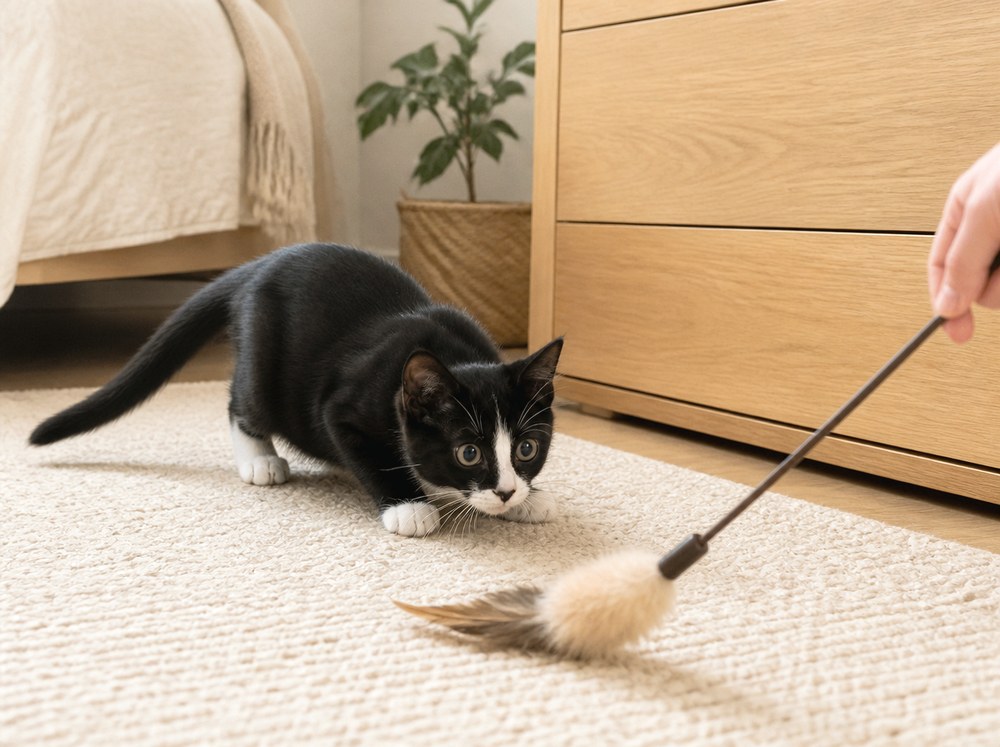
Use an interactive toy that lets the kitten stalk, chase, pounce, and move around the room. A wand-style toy can work well while you are actively supervising it. Short bursts of movement with brief pauses often suit kittens better than expecting nonstop exercise.
Try to make the play session engaging rather than simply waving a toy near the kitten’s face. Move the toy across the floor, around a piece of furniture, or behind a safe obstacle so the kitten has a reason to track it.
Watch the kitten rather than the clock. Slowing down, lying down between chases, losing interest, or becoming less coordinated can all be signs that the session has gone far enough.
Avoid using your hands or feet as toys. It can be amusing when a tiny kitten grabs a finger, but encouraging that habit can make biting and ankle-chasing much harder to manage as the kitten grows.
Once play is finished, put string toys, ribbon toys, wand attachments, and other items that could tangle around or be swallowed out of reach.
Follow Play With the Kitten’s Planned Evening Meal
For many kittens, feeding after active play creates a useful transition from excitement to settling down. The kitten gets to move, eat, groom, and then rest rather than going directly from an energetic game into an empty bedroom.
Keep the meal consistent with the feeding plan already appropriate for your kitten’s age, size, and health. Young kittens often need meals more frequently than adult cats, so bedtime should not automatically mean withholding food until morning. If your veterinarian, breeder, shelter, or foster caregiver gave you a feeding schedule, continue that plan unless you have a reason to discuss changing it.
Fresh water should remain available overnight.
This is also a useful time to notice how your kitten is doing. A kitten that usually approaches dinner eagerly but suddenly refuses food deserves closer attention, especially if the change comes with weakness, repeated vomiting, diarrhea, unusual hiding, breathing difficulty, or another sudden change. Contact a veterinarian when you are concerned rather than trying to solve a possible medical problem through routine changes alone.
Keep the Post-Meal Period Boring
After the meal, resist the temptation to begin another round of vigorous play. You are trying to change the pace of the evening.
Lower household activity, put away noisy toys, and let the kitten groom, explore quietly, or sit near you. Normal household sound is fine; the goal is not complete silence but a predictable shift from active time to calm time.
Reset the Litter Box Before Everyone Settles In
A clean, accessible litter box is one of the most practical bedtime preparations you can make.
Scoop the box before bed so your kitten has a clean place to use during the night. Make sure the route to it remains open and that a closing door cannot accidentally block access.
For a kitten still learning the layout of the home, it can help to keep nighttime resources within a manageable area rather than expecting the kitten to navigate several dark rooms. Place the litter box away from food and water, and choose a location the kitten can reach without climbing stairs, jumping over barriers, or passing something frightening.
If you recently brought the kitten home, maintaining the same litter type for a while may also reduce unnecessary changes during an already unfamiliar period.
Do not punish accidents. If your kitten suddenly starts eliminating outside the box after previously using it reliably, or you notice straining, repeated attempts to urinate, crying in the box, diarrhea, or another bathroom change, contact a veterinarian.

You May Also Like



Give the Kitten One Safe Nighttime Zone
New owners sometimes focus on finding the perfect kitten bed when the more important question is whether the entire sleeping area is safe.
Some kittens will curl up in the bed you bought. Others may prefer a folded blanket, an open carrier, a chair, or a quiet corner. You can offer a soft sleeping spot without expecting the kitten to stay in one exact location all night.
A smaller kitten-proofed room can be especially useful during the first days in a new home. It gives the kitten a familiar area containing the things it needs without unrestricted access to every part of the house.
Before bed, check the space at kitten height. Secure electrical cords. Put medicines, cleaners, small objects, hair ties, hooks, thread, ribbon, and chewable pieces out of reach. Close windows securely and make sure screens cannot be pushed out. Remove toxic plants and anything unstable enough to fall if climbed.
Put interactive string toys away after supervised play rather than leaving them available overnight.
The sleeping area should also have a comfortable temperature and a place where the kitten can retreat. Avoid creating a sleep setup that traps the kitten in bedding or forces it to remain next to a heat source.
You May Also Like



The Last 10–20 Minutes Should Feel Predictable
The final part of the routine does not need to entertain the kitten. Its job is to make bedtime uneventful.
You might sit quietly in the room, offer calm petting if the kitten seeks contact, tidy the feeding area, and then turn down the lights. If the kitten prefers to explore rather than cuddle, that is fine too.
Try to use the same handful of cues each evening. For example, the wand toy disappears, dinner is finished, the litter box is clean, the room becomes quieter, and the main lights go off.
Those environmental signals are more useful than insisting on an exact 10:00 p.m. bedtime every night.
A Flexible Bedtime Sequence
| Approximate point | What to do | Main purpose |
|---|---|---|
| 60–90 minutes before bed | Supervised active play | Give evening energy an appropriate outlet |
| 30–45 minutes before bed | Offer the planned meal | Transition from activity toward rest |
| 15–30 minutes before bed | Scoop litter and check water | Prepare overnight necessities |
| Last 10–20 minutes | Quiet interaction and low household activity | Create consistent wind-down cues |
| Bedtime | Leave the kitten in a safe, familiar sleep area | Support independent settling |
You can move the entire sequence earlier or later to match your household. Consistency in the order is usually more realistic than trying to follow the same minute-by-minute timetable every day.
What to Do When Your Kitten Cries After Lights-Out
Nighttime crying is common in a kitten that has just left familiar people, littermates, or surroundings. Before assuming the kitten is demanding attention, check the practical possibilities: Is the litter box accessible? Is fresh water available? Is the room comfortable? Could the kitten be frightened or trapped somewhere?
If those needs are covered, calm reassurance can be more useful than starting an exciting play session every time the kitten calls.
You might speak softly, sit nearby for a short period, or provide a familiar sleeping space close to where you sleep during the adjustment period. What you want to avoid is accidentally teaching the kitten that prolonged nighttime calling always starts a high-energy game.
At the same time, do not ignore signs of genuine distress. Persistent crying combined with weakness, breathing difficulty, repeated vomiting, diarrhea, appetite changes, bathroom problems, apparent pain, or a sudden behavior change should be discussed with a veterinarian.
When Midnight Zoomies Keep Happening
One imperfect night does not mean the routine has failed. Kittens are still developing their activity patterns, and moving to a new home adds another layer of adjustment.
If nighttime activity regularly becomes disruptive, look at the whole evening rather than simply adding more play at bedtime.
A kitten that sleeps through the busiest part of the evening may benefit from more interaction before the wind-down period. A kitten that becomes increasingly frantic during long play sessions may do better with several shorter sessions. If dinner happens much earlier than bedtime, shifting one planned meal closer to the evening routine may be appropriate, provided it still fits the kitten’s overall feeding needs.
Also check whether the nighttime environment itself encourages activity. Loose paper, dangling cords, noisy toys, objects that roll across hard flooring, or access to an exciting part of the home can turn a quiet room into a playground.
The solution is not to remove all enrichment from the kitten’s life. Instead, place the most stimulating interactive activities earlier in the evening and make the final environment safe and comparatively uneventful.
A Busy-Night Version Still Works
You will not always have an hour and a half available for a textbook evening. On a busy night, keep the anchors rather than abandoning the routine entirely.
A shorter supervised play session followed by the kitten’s normal meal, a quick litter scoop, fresh water, and a safety check can still preserve the familiar order. When your schedule returns to normal, expand the active portion again.
That makes the routine easier to maintain than one built around a rigid schedule you can follow only on ideal days.
What a Good Bedtime Routine Actually Looks Like
Success does not necessarily mean your kitten sleeps silently for the same eight-hour stretch you do.
A more realistic goal is a kitten that has predictable access to its needs, receives appropriate interaction before bed, can settle safely without constant entertainment, and gradually becomes familiar with the household’s nighttime rhythm.
Some kittens adjust quickly. Others need more reassurance and repetition after moving into a new home. Keep the sequence steady, make adjustments based on the kitten in front of you, and avoid changing five things at once.
For a new owner, the most useful starting point is straightforward: play first, follow the kitten’s appropriate feeding schedule, reset the litter box, remove overnight hazards, and make the final part of the evening calm. Repeat that pattern consistently and give your kitten time to learn what bedtime means in your home.
